

Education & Technical Training
Industrial 3D Printing Solutions for Engineering Education and Research
Today’s engineering education needs to use the same tools and materials found in modern manufacturing. Industrial 3D printers help universities, training programs, and research labs teach advanced manufacturing by letting students work with real engineering materials and equipment.
Industrial 3D printing platforms offer the control and reliability needed to simulate real manufacturing processes. This gives students and researchers hands-on experience with the same technologies used in aerospace, automotive, robotics, and other advanced industries.
AlphaAMT supplies and delivers industrial 3D printing systems from INTAMSYS’s wide range of 3D printers designed to support engineering education, applied research programs, and vocational training environments, preparing students for modern manufacturing careers.
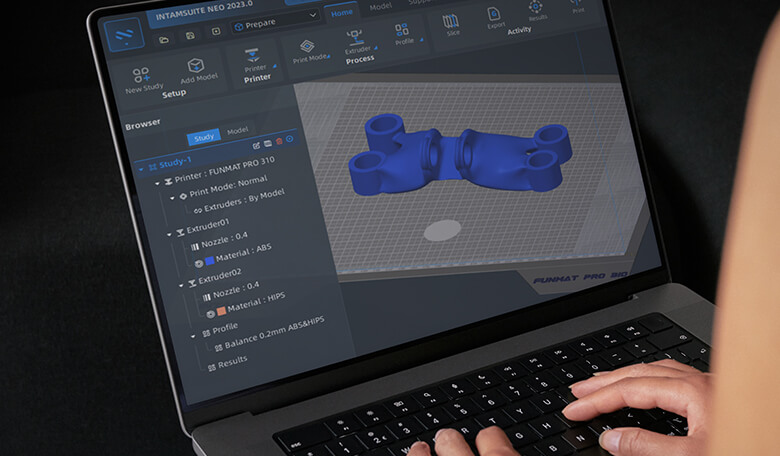
Additive Manufacturing in Engineering Education
Additive manufacturing is now a necessary part of most engineering and technical education programs. Industrial 3D printers enable students to go beyond the conceptual design and use engineering-grade materials to create functional components.
Educational institutions integrate additive manufacturing into programs such as:
- mechanical engineering
- aerospace engineering
- robotics and automation
- advanced manufacturing technology
- industrial design and product development
Operating with industrial-grade systems, students get experience in working with the real manufacturing processes, such as the processing of materials, machine work, and validation of parts.

Supporting Research and Innovation in Universities
Industrial 3D printers are widely used in university research environments where rapid prototyping and material experimentation are essential.
Research laboratories use additive manufacturing to produce components for:
- robotics research platforms
- aerospace and automotive prototypes
- experimental instrumentation
- mechanical testing components
- custom laboratory fixtures and tooling
Access to industrial additive manufacturing equipment allows research teams to accelerate experimental development and evaluate complex designs without relying on external manufacturing suppliers.

Preparing Students for Modern Manufacturing
Vocational training centers and technical colleges increasingly incorporate additive manufacturing into their curriculum to prepare students for careers in advanced manufacturing industries.
Industrial 3D printers allow training programs to teach:
- additive manufacturing workflows
- industrial machine operation
- material preparation and storage
- process parameter control
- part inspection and finishing
Practical training on industry equipment enables students to acquire practical skills that are in line with the actual production environments.
Competition like WorldSkills indicates the increased significance of advanced manufacturing technologies within technical education. Skills development programs worldwide are beginning to embrace additive manufacturing in order to assist students in proving their technical capability and innovation.
Industrial 3D Printers for Education and Training
Educational institutions require reliable systems capable of supporting both classroom instruction and research activity.
Industrial 3D printers offer the controlled conditions that are needed in engineering materials and repeatable production process.
Explore our range of industrial 3D printers suitable for engineering education, research laboratories, and technical training programs below.
Examples of systems commonly deployed in academic environments include:
FUNMAT PRO 310 NEO AND FUNMAT PRO 310 APOLLO
A compact industrial printer suitable for engineering laboratories and research programs where high-speed prototyping and engineering material processing are required.
FUNMAT PRO 410
A mid-size industrial system capable of processing both engineering plastics and high-performance polymers used in advanced research environments.
FUNMAT PRO 610HT
A large-format industrial printer designed for research programs working with high-temperature polymers and large engineering components.
These systems allow institutions to expose students to industrial manufacturing technologies within a controlled academic environment.
Materials Used in Engineering Education
Material selection is an important component of additive manufacturing education. Engineering students benefit from understanding how different polymers behave during processing and how material properties influence final part performance.
Explore our range of engineering materials commonly used in educational and research environments below.
Common materials used in engineering education include:
Polycarbonate (PC)
A strong engineering thermoplastic used for functional prototypes and mechanical testing components.
PC-ABS
Integrates both strength and toughness; hence, it can be applied in functional prototypes and product development projects.
PEEK
A high-performance polymer used in advanced research environments requiring excellent thermal stability and mechanical performance.
These materials enable the students to learn actual engineering polymers instead of entry-level plastics.
Hands-On Manufacturing Experience
Industrial additive manufacturing offers a useful, practical learning experience where students can explore:
- design optimization for additive manufacturing
- material behavior during processing
- structural performance of printed components
- dimensional stability in complex geometries
This is a practical exposure that empowers engineering education with the connection of theory to manufacturing practice.

Installation, Training, and Long-Term Technical Support
The integration of industrial additive manufacturing systems in educational institutions must be done through systematic onboarding and training.
AlphaAMT supports universities and training centers through:
- professional system installation and commissioning
- operator training for instructors and lab technicians
- guidance on material selection and printing parameters
- ongoing technical support and service
This ensures industrial 3D printers operate reliably within academic laboratories, training centers, and research facilities.
Explore Industrial 3D Printing for Engineering Education
If your institution is evaluating industrial 3D printers for engineering education, vocational training programs, or research laboratories, AlphaAMT can help identify systems and materials suited to your curriculum and research objectives.